
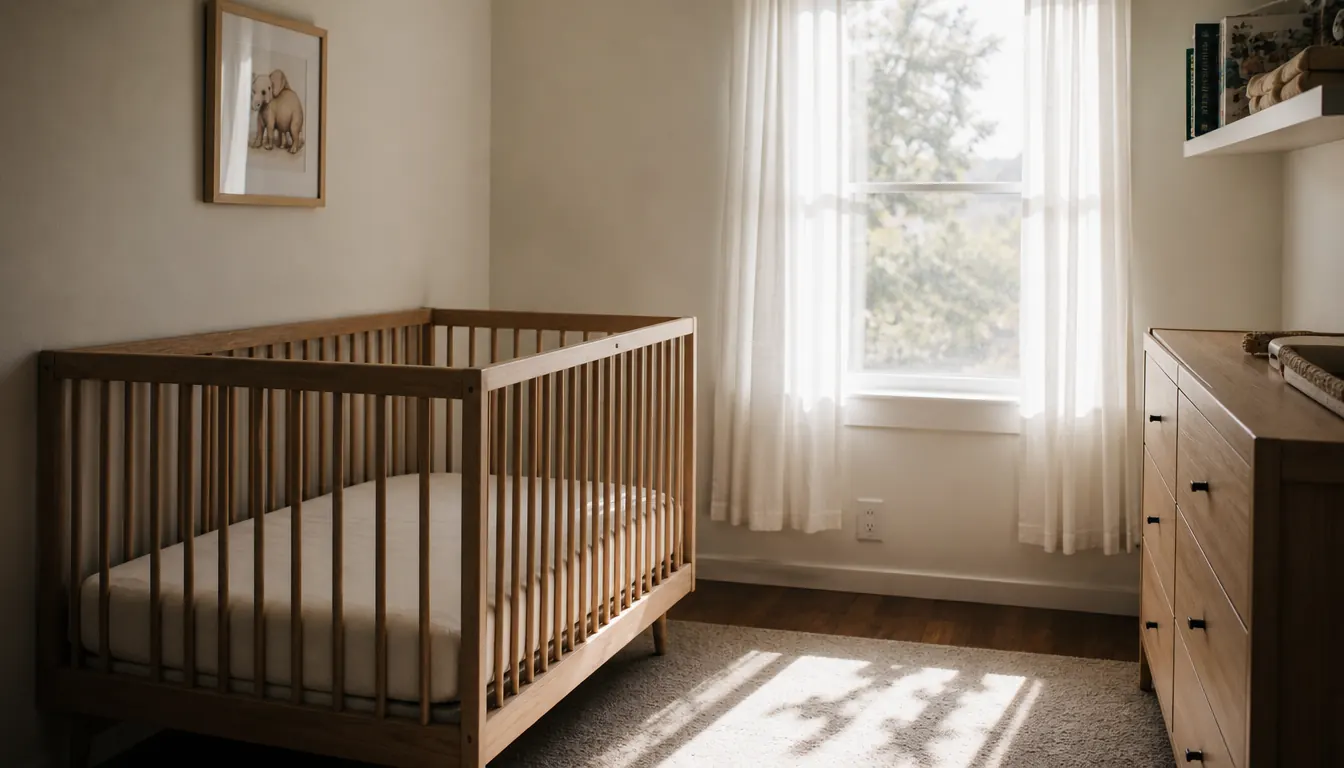
The first nap Milo ever took in his crib, I stood in the hallway and listened to the house instead of the baby. The furnace kicked on. A car door shut out front. The cat pushed through the screen door downstairs. In a two story house in Dayton, every ordinary sound in the world sounds like a baby waking up when you cannot see the crib. So about three weeks in, I did what most first time mothers do: I bought an audio monitor and hoped it would let me sit down for twenty minutes.
The one I bought is the VTech DM221, and it has been on the far wall shelf in the nursery for about nine months now, through every nap and every night since Milo moved into the crib in mid August. What follows is how I actually use it. Not the version in the manual. The version that has survived a baby, a furnace, a husband who leaves at 5:30 in the morning, and one very tired woman who kept walking back to the doorway to check on things she had just checked.
Hear the nap without standing in the doorway
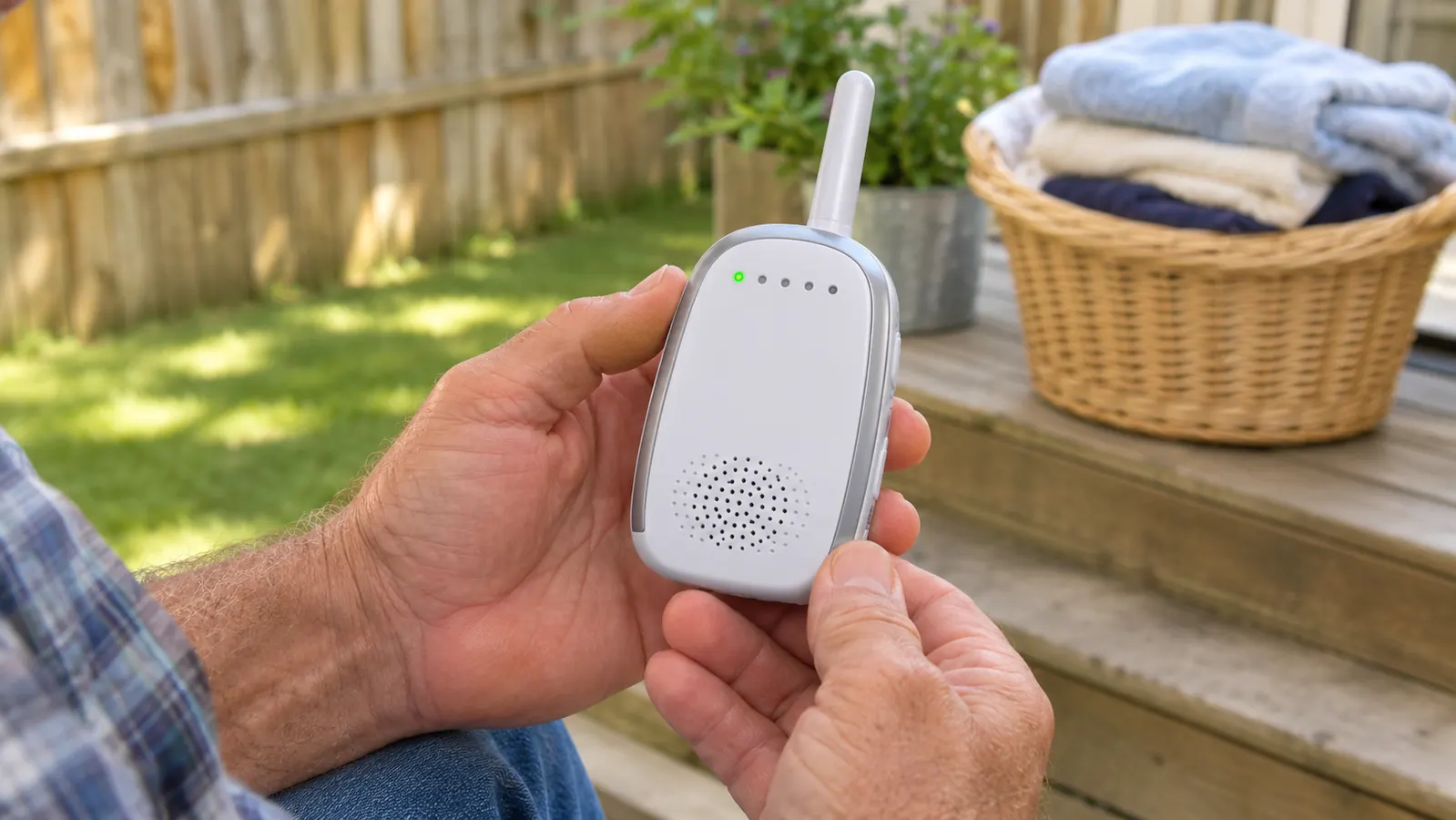
The VTech DM221 is the plain audio monitor I keep plugged in on my nightstand and carry down to the laundry. Five sound level LEDs, a rechargeable parent unit, up to 1,000 feet of range on DECT 6.0, and no screen to stare at at two in the morning. It is what lets me sit down during a nap instead of hovering by the door.
Amazon Check Today's Price on Amazon →Step 1: Put the Baby Unit Somewhere Boring
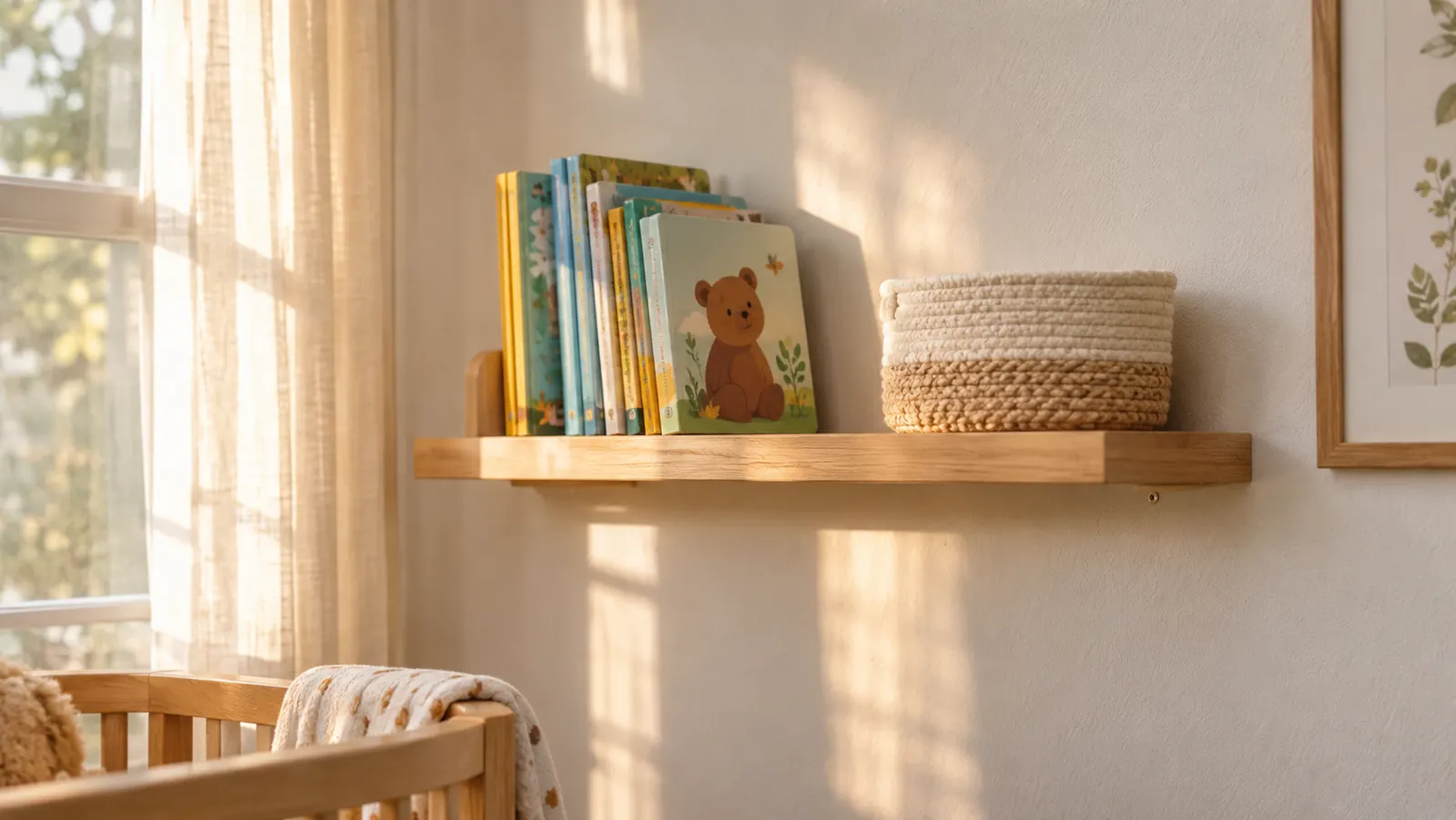
Mine sits on the shelf on the far wall of the nursery, with the cord run down behind the shelf where nobody can reach it. That is the entire installation. No drilling, no wall mount, nothing attached to the crib rail, nothing draped over the side. It took me about four minutes and most of that was finding an extension cord. I also measured it, because the manual's version of nearby and mine were not the same thing: the shelf ends up about four feet from the crib rail, close enough to pick up a stir, far enough that I am not tempted to lean in and adjust it mid nap.
I know why the temptation is to clip it to the crib so the sound is right there in the mattress. Please do not. Cords near a crib are a strangulation risk, and the safe sleep basics are blunt about it: baby on his back, on a firm flat mattress, with nothing loose in the crib and nothing hanging into it. A monitor does not change any of that. It is not a medical device. It does not prevent anything and it does not keep a baby safe from anything. All it does is let you hear the room from somewhere else in the house.
Point it out into the room, not into a corner or at a wall. The baby unit picks up the whole nursery, so a shelf facing the middle of the room will catch a stir from the crib better than a unit wedged behind a bookshelf. Keep it away from the window on a cold night and away from anything that rattles when the heat comes on. I got that wrong at first. I had the unit facing the window because the shelf happens to point that way, and every car going down the street came through the speaker as a soft whoosh. Turning it to face the crib and the door fixed it in about ten seconds.
Step 2: Set the Sensitivity During a Wake Window, Not at 2 A.M.
There is an adjustable sensitivity setting, and where you land on it matters more than any other choice you will make with this monitor. Set it in the afternoon with the baby awake and babbling in the crib, then walk to the far corner of the house and listen. I did mine on a Tuesday in March with Milo in the crib for a wake window, chattering at the ceiling, and I walked from the basement stairs to the back door and back until I could hear him from the bottom step and not from the top.
The first two nights I had it turned so high that the furnace in the basement came through like a foghorn. I got up four times for nothing, which is its own kind of exhausting when you are already up twice for real. I turned it down until I could hear him fussing but not the heat cycling, and the house went quiet again.
Do the setting while the noise is actually happening. Nate is an HVAC technician and he can tell the difference between the furnace kicking on and a baby stirring from two rooms away, which is a skill I do not have and do not want. If your house creaks in the evening, set the monitor in the evening. If a dog next door barks at the mail truck every day at noon, set it at noon. You are tuning out your house, not a silent showroom. This took me three nights of fiddling, and I would have saved myself all of them by walking the house with the parent unit in my hand before bedtime instead of after.
Step 3: Learn the LEDs Instead of Listening Through a Wall
There are five sound level LEDs on the parent unit, and they are the reason I stopped bringing a video monitor to bed. One LED means he shifted in his sleep. Three means he is fussing and might settle. Five means he is awake and unhappy and the nap is over. You are not listening through a wall trying to interpret a crackle. You are reading a level, the way you read a clock. On the VTech the lights are the whole message, and they work whether I have my glasses on or not.
Here is what that actually looks like at two in the morning. I am in bed. The first LED flickers and I go back to sleep. The third, I sit up. By the fifth I am already across the hall. That is the whole system, and it is the reason this monitor stayed on my nightstand while the video screen moved to Nate's.
I want to be honest about the tradeoff, because it is real. There is no picture. When those LEDs hit five, I still get up and walk nine steps across the hall and look in the crib with my own eyes. I decided early that nine steps was a fair trade for not lying awake watching a screen. If you are the kind of person who needs to see the chest rise, an audio monitor will not fix that for you and I am not going to pretend it will. I kept the VTech on my nightstand for exactly this reason, and the video screen lives on Nate's side now.
Step 4: Keep the Parent Unit Plugged In and Carry It Where You Actually Go
The parent unit runs on a rechargeable battery or off the adapter, and I would not buy this for the battery. A full charge takes 12 hours and the cordless run is short, so for continuous use it stays plugged in. Mine lives on my nightstand, plugged in, every night since mid August, and it has never gone flat on me because it is never running on the battery in the first place.
During the day it comes with me. Kitchen while I make lunch, living room while I fold, the basement where the laundry is, and out the back door when I am at the clothesline by the back fence. The listed range is up to 1,000 feet on DECT 6.0, and my house plus the yard sits comfortably inside that. The walls upstairs are thick and the signal goes through the floor without complaint. The only place I have ever had a little static is the far corner of the basement, past the furnace, and even there I can still hear him.
On yard days I switch on the vibrating sound alert. Standing behind a wet sheet, I cannot see a light on a nightstand, but I can feel the unit buzz against my hip, and that is the difference between finishing the laundry and sprinting inside every ten minutes to check. That is the only time I use the vibration, and it earns its place. The rest of the week I forget the feature exists, which is how I know it is set correctly.
Step 5: Turn Off the Parts That Fight the Nap
There is a night light on the baby unit. Mine has been off since the first week. Not because there is anything wrong with it, but because the nursery already has a sound and light machine doing that job on the dresser, and one source of light in a dark room is enough. If your baby is used to a room with no glow in it, adding a light on the shelf is a change nobody asked for at bedtime.
The talk back intercom is the feature I wanted to love and stopped using. In the first month I pressed it from the hallway to say something soothing, and the sudden voice coming out of the shelf startled Milo into a full cry. He was three weeks old. I have not touched it since. An older baby who already knows your voice coming out of a box may feel differently about it. Mine did not care for it at all.
Once those two are off, the monitor gets out of the way. You put the baby down, you walk out, and the parent unit tells you whether to come back. That is the whole job, and a monitor that does one job quietly is worth more than one that does six things loudly.
What Else Helps
An audio monitor solves exactly one problem: hearing the nap from another room. It does not make the room dark and it does not make noise. Two other things did more for our naps than the monitor ever could, and neither of them is a gadget you have to think hard about. The VTech does the listening. The blind and the sound machine do the sleeping conditions.
The first is the blackout blind on the nursery window. The east sun hit the crib wall by seven in the morning and those naps were twenty minutes long. The blind went up the week before Milo was born and has stayed up since, apart from one wash and one weekend at my mother's house in Erie. A dark room was the single biggest change we made to napping, and the monitor is what lets me leave that dark room once he is down.
The second is a sound and light machine on the dresser, about seven feet from the crib, with one routine attached to it: feed, one book, the light dims, the pink noise comes on, and he goes down awake. When Milo moved into the crib in mid August the first two weeks were rough, and that routine was the thing we held onto. None of this is medical advice and none of it promises a baby will sleep. Milo still wakes some nights. He sleeps on his back, on a firm flat mattress, with nothing loose in the crib, and I check that every single night whether the monitor is on or not. If you have questions about your baby's sleep, ask your pediatrician. Dr. Bell has answered more of my late night questions than I can count, and she has never once promised me a full night either.
The first LED flickers and I go back to sleep. The third, I sit up. By the fifth I am already across the hall.
The monitor that let me stop standing in the hallway
DECT 6.0, up to 1,000 feet of range, five sound level LEDs, and a parent unit that stays plugged in where you actually are. It has run every nap in this house for nine months and it has never once asked me to open an app.
Amazon See the VTech DM221 on Amazon →