
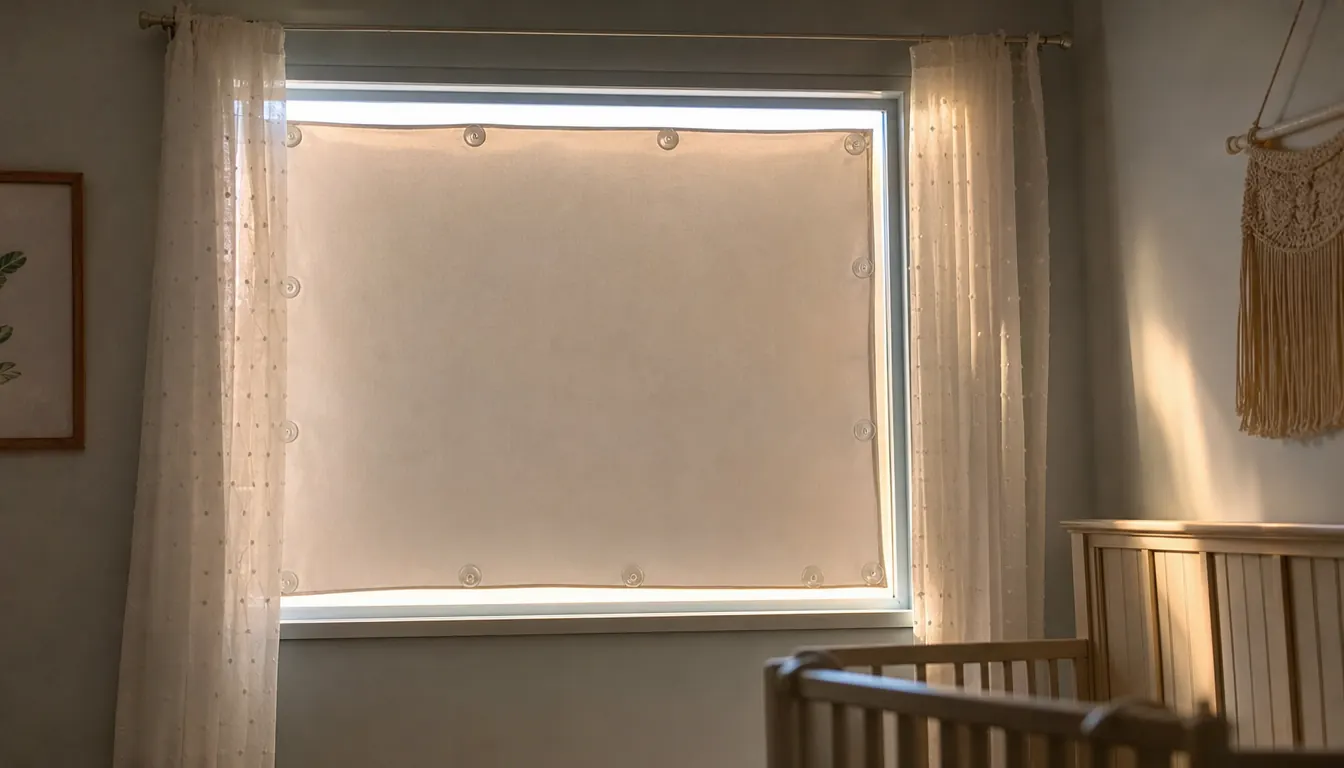
Nobody warns you that the hardest part of a nursery is the window. Ours faces east, and by seven every morning in spring the light came through the thin white curtains that came with the house and landed on the wall beside the crib. Milo would go down for his nine o'clock nap, sleep about forty minutes, and come up blinking at the ceiling like something had switched him back on. I moved the crib to the inside wall, away from the window. It still happened. Light does not stay where you put it.
So the Tommee Tippee Sleeptime Portable Blackout Blind went into the one Amazon order I placed in January, three weeks before my due date, next to the monitor and the sound machine and the swaddles. I had never owned a blackout blind. Nobody handed one down to me. It went up on that window the week before Milo was born on February 10, and it has been there about nine months since. There are things about it I would have wanted to know on day one, and that is the whole reason for this page.
The Quick Verdict
It does the one job, and it does it well enough that morning stopped setting our schedule. The suction cups are the weak point, fitting takes a few minutes every time, and it looks plain as anything from the street.
Amazon Check Today's Price →The sun stopped deciding when the nap ended.
The Tommee Tippee blind is suction cups all the way around, adjustable fastenings to fit a window up to about 51 by 78 inches, and a travel bag for the one weekend a year you need it off the glass.
Amazon Check Today's Price on Amazon →How I've Used It, Month by Month
The blind went up the week before Milo was born, which means it has been on that glass longer than he has been alive. I fitted it while I was still pregnant and could stand on a step stool without thinking about it. That first fitting took a few minutes, mostly because I was learning how the fastenings work and kept second guessing the corners. The second fitting took less. By the fifth I could do it without looking.
It has come down exactly twice since February. Once in June, for a machine wash. Once in July, for a weekend at my mother's house in Erie, Pennsylvania. That weekend is the only trip this blind has taken. The HelloBaby monitor went with us. The VTech and the Hatch stayed home. So if you are looking for somebody who has folded this thing into a suitcase forty times, that is not me, and I am not going to write as though it is.
What I can tell you honestly is what it did to the room. Once the blind was up, that nursery went dark at seven in the morning and stayed dark until I peeled a corner back. Dark enough that I stopped using the room to play in. Milo plays downstairs now, on a rug in the living room that is not stylish and does not need to be. The nursery is for sleeping, for changing and for the sound machine. The blind is the reason it works that way.
Nate works HVAC and is up at five thirty on weekdays, so he is the one who sees that room at its darkest. His verdict, in his own words, is that it is the only thing in the nursery that does exactly what the box says it does. He has never fitted it himself. I want that on the record too.
What Nobody Tells You: It Is Not a Fixture
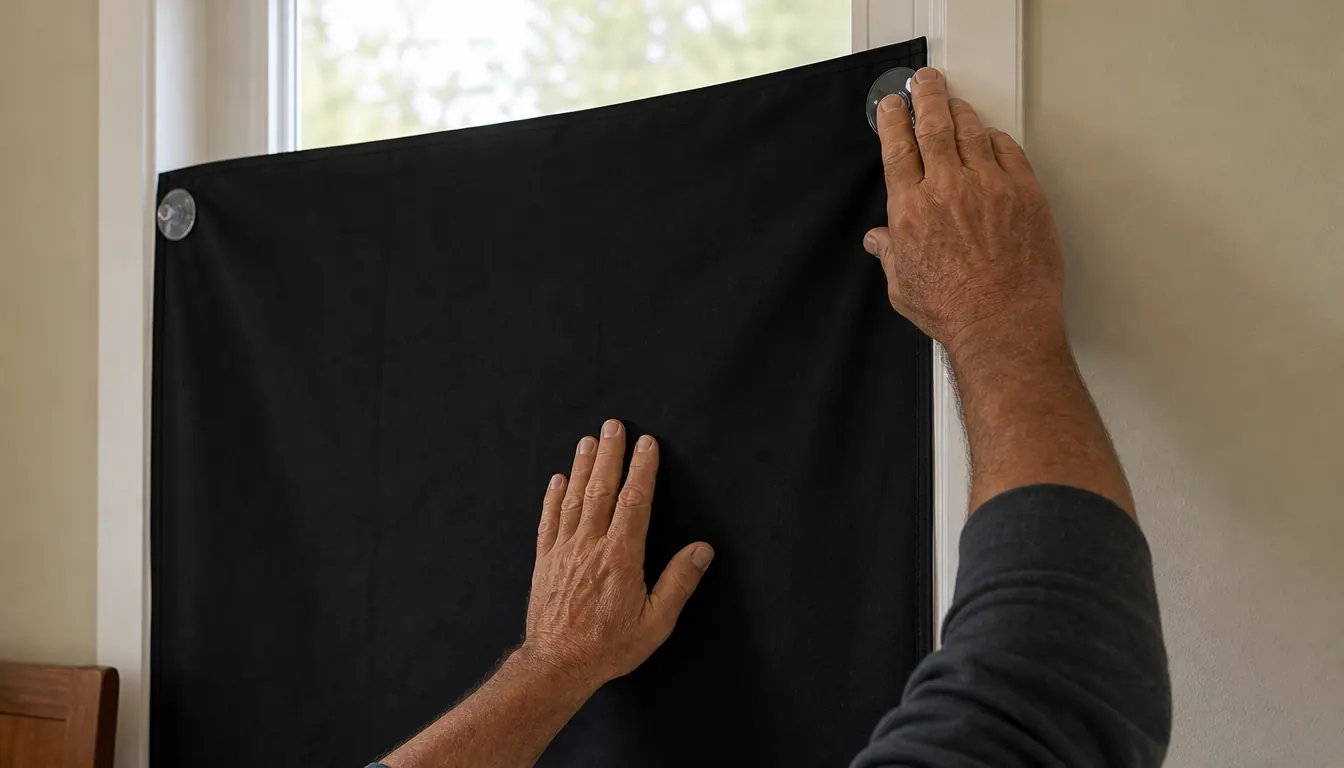
Some part of me expected a blind. A roller, a cord, something that lives on the window and pulls down and stays put. This is not that. The Tommee Tippee blind is a rectangular sheet of blackout polyester with suction cups fitted all the way around the edge, and it presses flat against the glass, inside the frame. That is the whole design, and it works, but it is a different relationship with your window than most people picture when they read the word blind.
The good part of that is coverage. A curtain hangs, and light finds the gap at the top and the sides. This goes edge to edge and seals against the glass, so there is no gap to find, or almost none. The trade is that you fit it and you refit it. If you want daylight in that room at three in the afternoon, you take it off the glass and you put it somewhere. There is no halfway, no cord to pull to a stop in the middle.
The other thing nobody says out loud is that from the street it looks plain. Genuinely plain, like a sheet pressed onto a window. Our neighbor has never commented, which I choose to read as politeness. If the window in question faces the road, that matters and you should know it now. Ours faces east over a fence and a strip of grass, and I stopped caring by March.
The Suction Cups Are the Entire Product
Everything about how this blind behaves comes down to those cups. When they are seated, the seal holds and the room goes dark and the sheet does not move, even with the window open a crack on a breezy afternoon. When one lets go, and one does let go now and then, you get a triangle of light in a corner and you find out how quickly a baby notices a triangle of light.
Fitting them is a small skill. You wet the cup, you press it, you hold it for a second, and you work your way around the edge. The first time I did it, I pressed two, got distracted, and came back to find they had slid. On cold glass in January they are less forgiving than they are in July. None of this is difficult. It is just not nothing, and if you are picturing something you hang once and never touch again, adjust the picture before you buy.
And because this is a nursery, one plain thing needs saying. A blind is not a safe sleep item. It does nothing for a baby's breathing or his risk of anything, and it should not be sold or read as though it does. What it changes is light. The crib rules did not change when I put it up. Milo is on his back, on a firm flat mattress, with nothing loose in the crib, and the blind lives on the glass and nowhere near him. If you have questions about your own baby's sleep, that is a conversation for the pediatrician and for current safe sleep guidance, not for me.
Sizing: 51 by 78 Inches Is a Ceiling, Not a Promise
The listed size is 51 by 78 inches, and the fastenings let you adjust it smaller to fit the window you actually have. Our nursery window is smaller than that in both directions, so I gathered the extra and fastened it down and it has stayed gathered for nine months. That is the design working. It also means the fit is something you build, not something that arrives done, and a window with an unusual shape, a deep sill or a crank handle in the middle of the glass is going to fight you every single time.
Measure the glass, not the frame, and measure it before you order. That is the most useful sentence on this page. I measured after mine arrived, which is the wrong order to do it in, and I got lucky because the window happened to be a plain rectangle.
Travel: The Bag Is Real, the Use Case Is Smaller
It folds down to about 11 by 9 by 2.4 inches and goes into a travel bag that comes with it. That is genuinely small. It went into the car for Erie alongside a pack of crib sheets and a suitcase, and it did not take up space I missed.
On my mother's window it fitted in about four minutes and did the same job it does at home. That is the argument for the bag. The counterargument is that unless you are regularly sleeping somewhere that is not your own house, the bag is mostly a nice thing to have on a shelf in the basement. We have used it on one trip in nine months. If you go to the same relative every few weeks, that math changes completely, and this is a far better answer than packing curtains.
Worth saying plainly: the blind goes on a window, not on a travel crib. If the place you are staying has no window you can reach, or has one of those deep decorative sills, the bag does not rescue you. Ask before you pack.
Washing It, and What Nine Months Looks Like
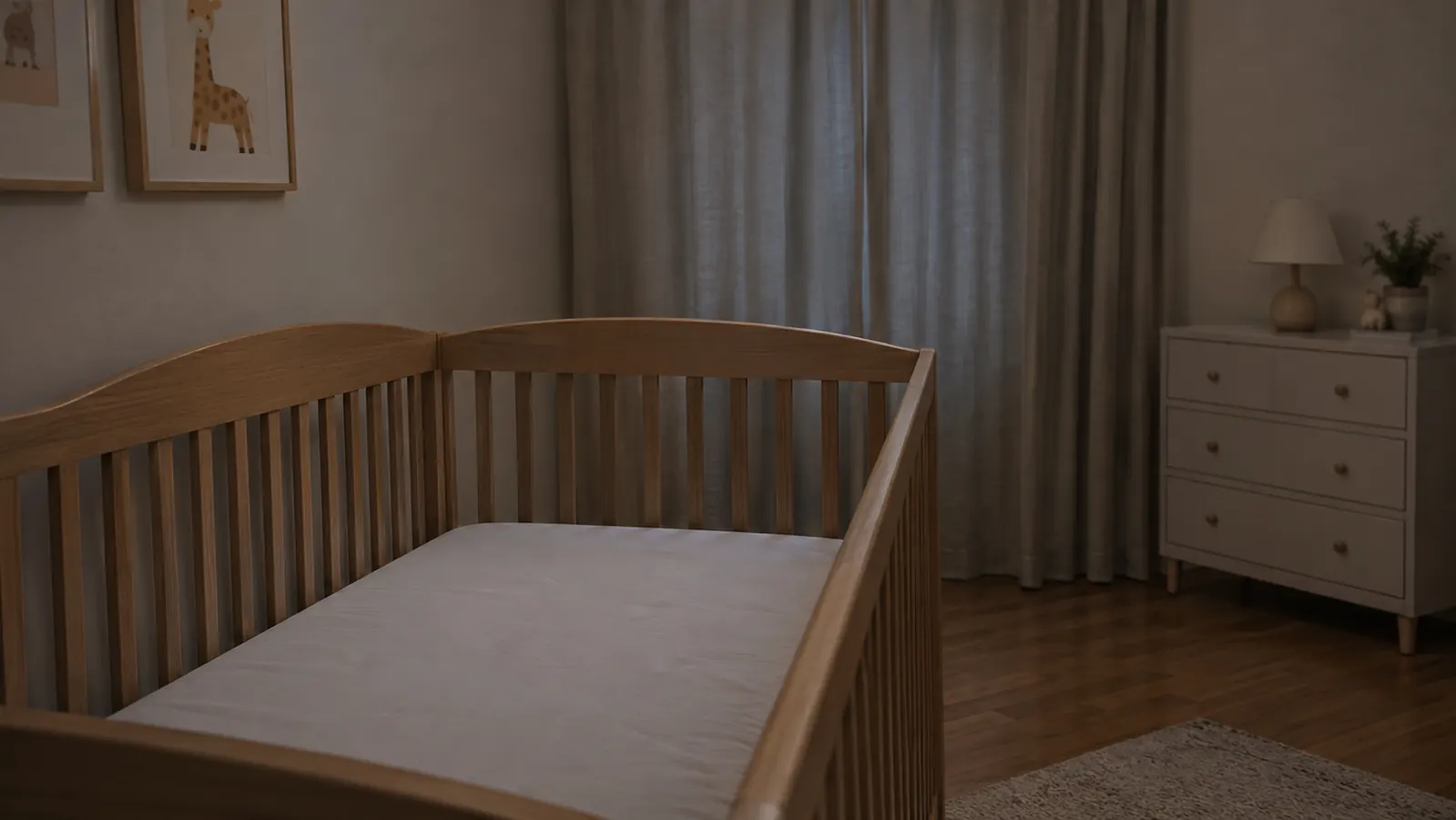
It is machine washable, and I did that once, in June, then hung it to dry over the basement stairs. It came out the same size, which was my entire worry, and the cups went back on without a fight. The material is polyester and it has not held a smell or a stain. Nine months on a sunny window and it looks like it did in February.
The honest summary of living with it is that it is invisible when it works and irritating for about four minutes when it does not. It is not pretty. It is not a design choice you make for a room. It is a plain rectangle that solves a light problem, and I would buy it again, which is a different sentence from saying I like it.
What It Did Not Fix
I want to be careful here, because a blackout blind gets recommended so often that it starts to sound like a solution to sleep itself. It is not. It fixes light. Milo still wakes some nights. He woke at two and again at five the week I am writing this, in a room that is genuinely dark. No product I have bought has changed that, and the ones that claim to are selling you something I have not seen work.
What it did fix is the mornings. Before the blind, the room was bright by seven and the nap that should have run to ten was over at nine forty. After the blind, the room stayed dark and the nap got longer, most days. I am not going to tell you your baby will sleep longer, because I do not know your baby and neither does a piece of polyester. I am telling you our room got darker and our mornings got quieter, and those two things are related but they are not the same.
It also did not fix the monitor question. I still keep the VTech on my nightstand and give Nate the screen, because I could not stop staring at the video at night and was sleeping badly because of it. The blind has nothing to do with that. I mention it because this page is supposed to be honest about the whole room, not just the one item in front of you.
What I Liked
- Seals against the glass, so there is almost no light leaking at the edges
- Adjustable fastenings fit a window up to about 51 by 78 inches
- Folds to about 11 by 9 by 2.4 inches into a travel bag that comes with it
- Machine washable, and it came back the same size after a June wash
- Nine months on an east window with no wear showing on the sheet
Where It Falls Short
- Suction cups need wetting and pressing, and one corner lets go now and then on cold glass
- Fitting takes a few minutes, and you do it again every time you want light in the room
- It looks plain from the street, like a sheet pressed onto the window
- No halfway setting. The room is either covered or it is not
- The nursery stays dark all day, so play moves downstairs
It has come off that window twice in nine months. Once for a June wash, once for a weekend in Erie. That is the entire maintenance story.
Who This Is For
Parents with one bright window and a baby who treats sunrise like a starting pistol. East facing, west facing, a streetlight outside, a security light next door, a room that takes hot afternoon sun and will not cool down. Renters especially, because this goes on the glass with suction cups and leaves nothing behind. No screws, no brackets, no holes to explain to a landlord.
It is also for people who go back to the same house over and over. One blind, one bag, one relative. If you are at your mother's every month, this earns its place in the trunk.
Who Should Skip It
Skip it if the window is one you care about from the outside. Skip it if you want to open the curtains in the afternoon and let light in without taking something off the glass first. Skip it if your window has a deep sill, a crank, or a shape that is not a rectangle, because you will fight it every time and eventually you will stop putting it back up.
And skip it if what you actually want is a room that looks finished. Curtains do that. I have never owned blackout curtains, so I will not pretend to grade them from experience, but I know what they look like and I know what this looks like, and it is not the same. The blind wins on fitting tight against the glass and on going into a bag. Curtains win on how the room reads when someone walks in. Decide which of those you are shopping for before you order either one.
If light is setting your schedule, start with the window, not the crib.
Nine months on an east window. Two removals. One wash. One trip. Suction cups around the whole edge, adjustable to fit up to about 51 by 78 inches, and a travel bag for the weekend you need it.
Amazon Check Today's Price on Amazon →